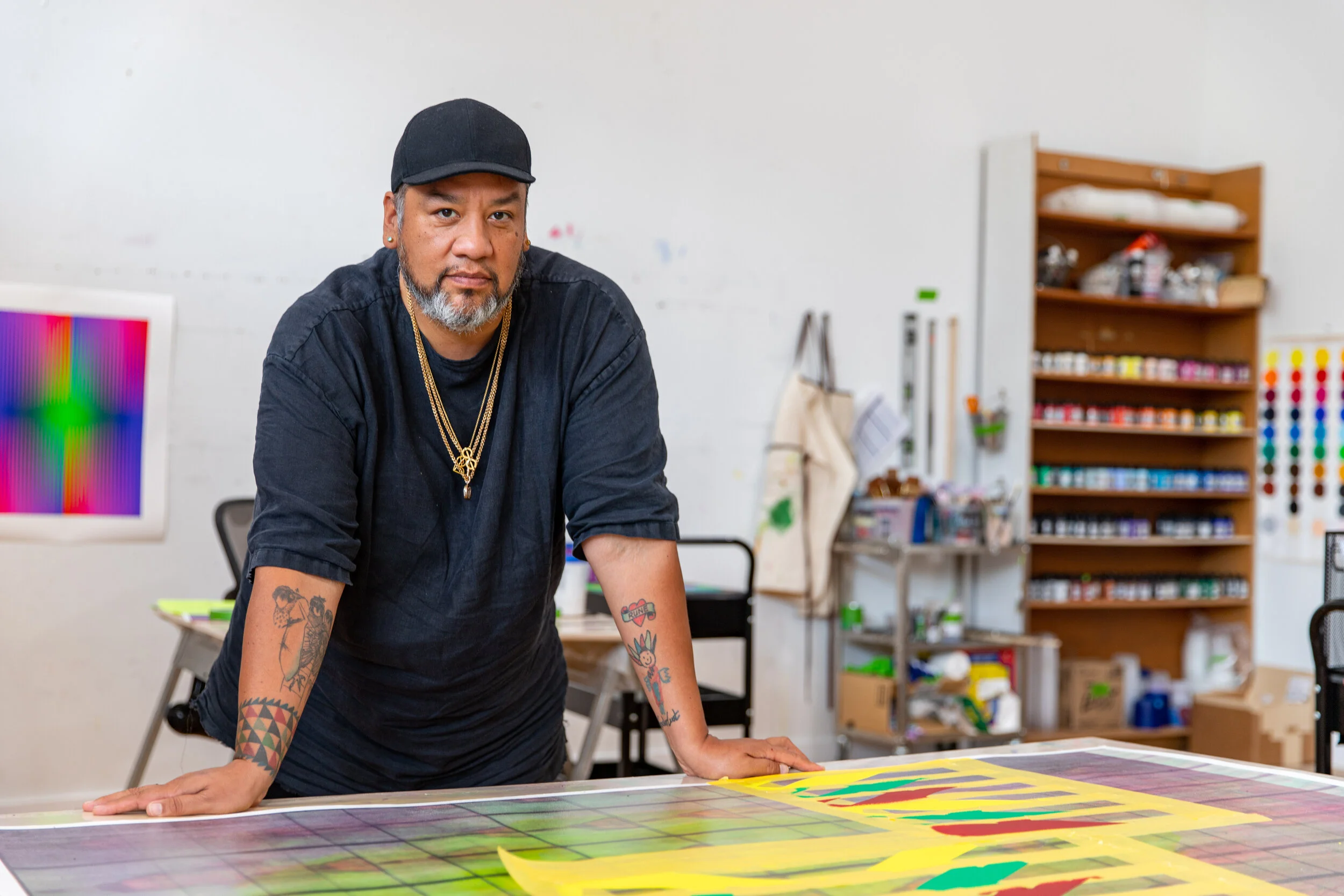
Jeffrey Gibson
Nothing is Eternal (2020) by Jeffrey Gibson
Video Projection at WallTime
Houston and Bowery, NYC
November 13 - 20
8 pm each night
In collaboration with Art at a Time Like This and the CCA Wattis Institute for Contemporary Arts, For Which It Stands presents a new video projection by artist Jeffrey Gibson. View the film from November 13 to November 20 on WallTime at Houston and Bowery, each night at 8PM. Gibson’s Nothing is Eternal, a newly commissioned video with musical composition, was conceived during this pandemic era. The immersive video work depicts the American flag in unsettling stillness, as a marker of territory, and projected onto bodies, while set to a heartrending soundtrack. At once melancholic and beautiful, Gibson renders the iconic image of the flag as both elastic and unyielding. The slow transformation through time, color, and form reflects both a distillation of our social collapse and the reinvention of self and community, referencing the movement and change that is so desired for this nation.
OPENING NIGHT PARTY, 7:30 - 8:30PM; VIDEO PROJECTION BEGINS, 8pm.
To hear the soundtrack at the site, please download the WALLTIME app on your phone
Nothing is Eternal is an occasion to gather and to strengthen community at this time of celebration and uncertainty. Celebrants are invited to view the work and share their post-election fears, excitement, and energy. Simultaneously, the video will be presented online at www.artatatimelikethis.com and www.forwhichitstands.art Many thanks to the Ford Foundation Gallery, Assembly Room, and Walltime for support of this outdoor and online public event.
Image above: Photo Courtesy of Jeffrey Gibson Studio, Photo By: Brian Barlow.
Above: Jeffrey Gibson, Nothing Is Eternal, 2020, Single-channel digital video, sound, 18:14 min, Courtesy of the artist, Sikkema Jenkins & Co, Kavi Gupta Gallery, and Roberts Projects.
Jeffrey Gibson (b. 1972, Colorado, US) is an interdisciplinary artist and craftsperson based in Hudson Valley, New York. His work references various aesthetic and material histories rooted in Indigenous cultures of the Americas, and in modern and con- temporary subcultures. Gibson, a member of the Mississippi Band of Choctaw Indians and of Cherokee descent, is forging a multifarious practice that redresses the exclusion and erasure of Indigenous art traditions from the history of Western art as it explores the complexity and fluidity of identity.
Previous exhibitions include, Jeffrey Gibson, LIKE A HAMMER, organized by the Denver Art Museum, and This Is The Day, organized by The Wellin Museum. Other notable solo exhibitions include: The Anthropophagic Effect (2019) The New Museum, New York; Look How Far We’ve Come! (2017), Haggerty Museum of Art, Milwaukee; Jeffrey Gibson: Speak to Me, (2017), Oklahoma Contemporary Arts Center, Oklahoma City; and A Kind of Confession (2016), Savannah College of Art and Design Museum, Savannah. Gibson is a recipient of a 2019 MacArthur Foundation grant.
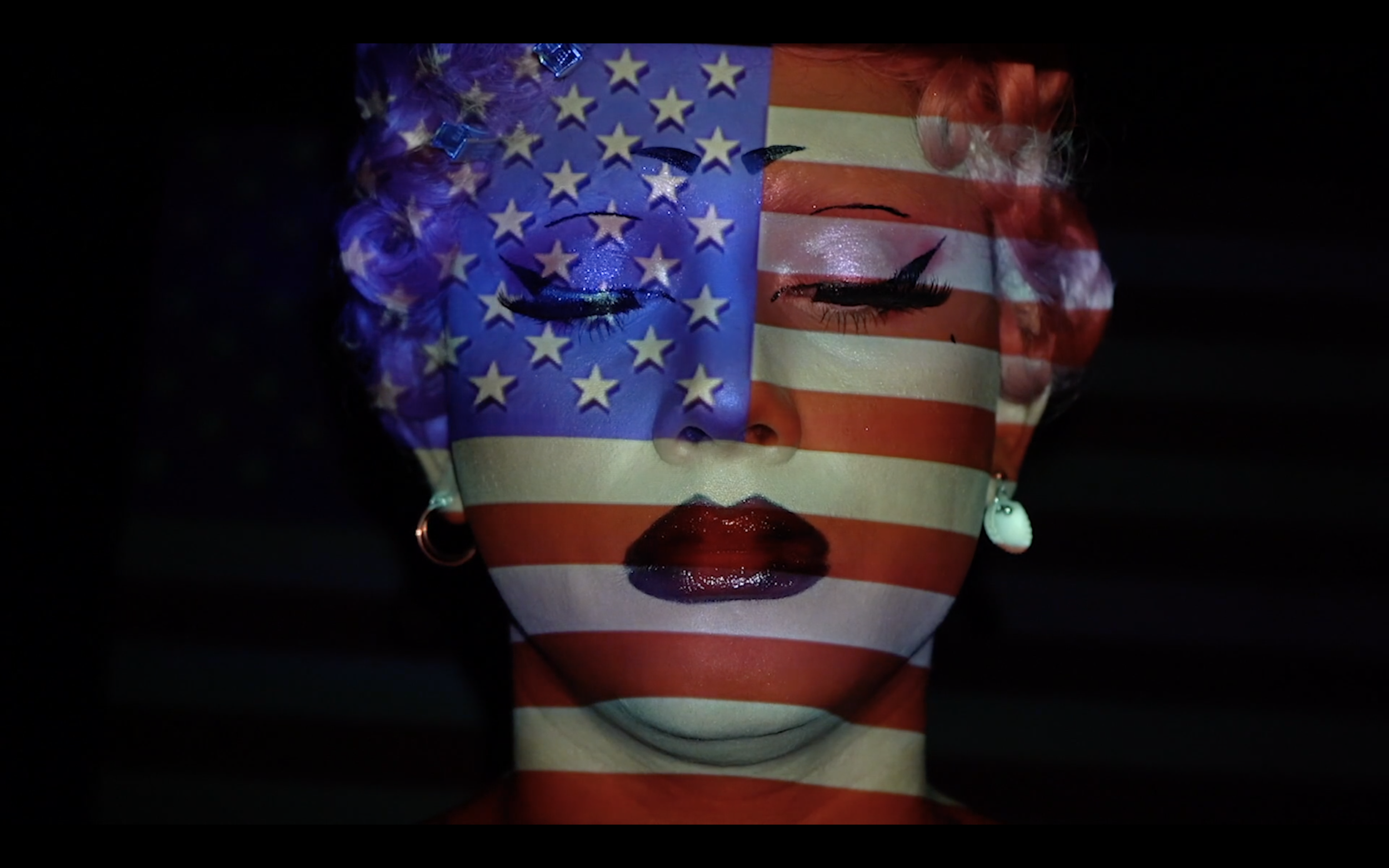
Image above: Film still - Jeffrey Gibson, Nothing Is Eternal, 2020, Single-channel digital video, sound, 18:14 min, Courtesy of the artist, Sikkema Jenkins & Co, Kavi Gupta Gallery, and Roberts Projects.
Artist’s statement:
Each time you love, love as deeply as if it were forever only, nothing is eternal.
- Audre Lorde (born February 18, 1934, died November 17, 1992)
Nothing Is Eternal is titled after a quote from poet, writer, feminist, lesbian and civil rights activist, Audre Lorde. I have returned to this quote often to remind myself that in the face of injustice, inequities and fear, that it is crucially important to love and to let those around you know that they are loved.
I began making this video during the first weeks of Covid - 19 quarantining. I, as many of us, felt overwhelmed with the weight of the onset of a global pandemic amidst an already increasingly divided country and world. It immediately became a political issue that highlighted the inequities within American culture and the media proved to heighten the sense of us versus them. Then on March 13, 2020, the shooting of Breonna Taylor by local police, and on May 25, 2020, the murder of George Floyd, also by local police, ignited an eruption of protests that continue to draw attention to the history of violence towards black men, women and children. They were not the only black lives lost during this time, and I could not forget the history of and the current number of undocumented missing and murdered Indigenous women, among so many others. I struggled with the question of how and why create during times like these. Is it important to leave behind examples of how one felt during times like these? I think it is.
People began putting the American flag up in their front yards and in storefronts in my local area. I was used to seeing the flags flying publicly as a sign of unity, to put our differences aside come together, but this was different. The flags began to feel aggressive and exclusionary.
Nothing is Eternal tracks my impulses during this time. My attempts to stabilize myself, to see myself, to see others, to feel, and to try and focus and not lose sight that there is a future on the other side of this particular moment. The challenge is not to hold on too tight, not to retreat into our past habits and comfort zones, to allow change to happen even if it makes us feel destabilized and uncomfortable. We may be in this space for a while. Please remember Audre’s words.
“Each time you love, love as deeply as if it were forever only, nothing is eternal.”
* I want to note that I am aware many other injustices are happening concurrently but chose to speak about Black and Indigenous communities here in this statement. - Jeffrey Gibson